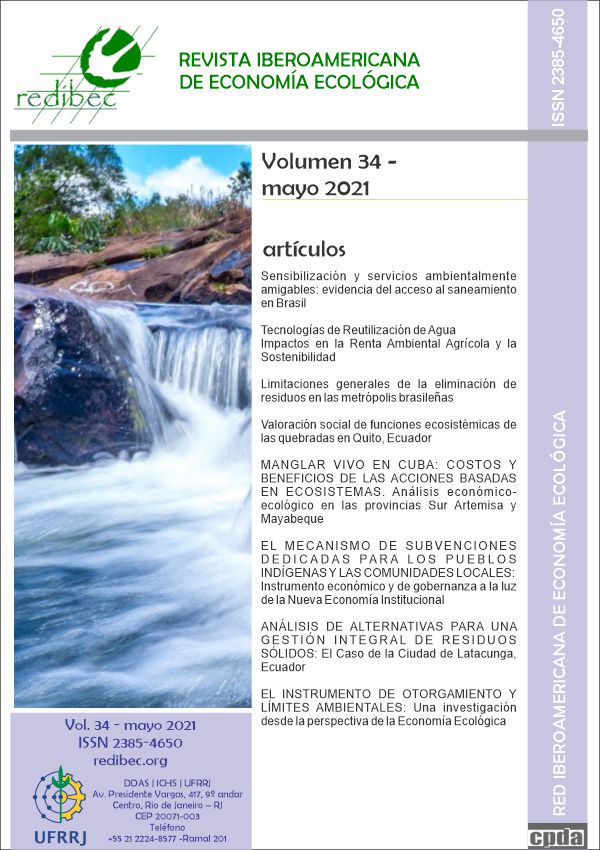
Limitaciones generales de la eliminación de residuos en las metrópolis brasileñas
Palabras clave:
comportamiento proambiental, educación, eliminación de residuos, áreas urbanas, logit multinomialResumen
Uno de los principales problemas ambientales derivados del actual proceso de urbanización es la excesiva generación de residuos residenciales y su inadecuada disposición. Este estudio analiza las condiciones socioeconómicas y demográficas que influyen en la forma en que se desecha la basura en los hogares de las metrópolis brasileñas, utilizando el modelo Logit Multinomial, con base en datos de la Encuesta Nacional de Hogares por Muestra-PNAD. Los principales resultados de la encuesta sugieren que los límites superiores de educación (educación secundaria, superior y posgrado) reducen la probabilidad de eliminación incorrecta de residuos. Otros factores que mitigan la eliminación incorrecta de desechos son los ingresos, el género y el uso de Internet. Además, el nivel de educación del jefe de familia y si el jefe de familia es una mujer se reflejan en las actitudes de otros miembros del hogar. Estos resultados apuntan a la necesidad de ampliar las políticas educativas, incluida la educación ambiental, que pueden promover externalidades positivas y pueden contribuir a la difusión de comportamientos proambientales.
Referencias
AAKVIK, A., SALVANES, K.G., VAAGE, K. 2010. Measuring heterogeneity in the returns to education using an education reform. European Economic Review, vol. 54 (4): 483–500.
ACEMOGLU, D., ANGRIST, J. 2001. How Large Are Human-Capital Externalities? Evidence from Compulsory Schooling Laws 15. MIT Press, Cambridge and London.
ALAUDDIN, M., SARKER, M.A.R. 2014. Climate change and farm-level adaptation decisions and strategies in drought-prone and groundwater-depleted areas of Bangladesh: an empirical investigation. Ecological Economics, vol.106: 204-213.
ANGRIST, J.D., KRUEGER, A.B. 1991. Does compulsory school attendance affect schooling and earnings? Quarterly Journal of Economics, vol. 106(4): 979–1014.
ANTONI, G.D., MARZETTI, G.V. 2019. Recycling and waste generation: An estimate of the source reduction effect of recycling programs. Ecological Economics, vol. 161: 321-329.
BLOCKER, T.J., ECKBERG, D.L. 1997. Gender and environmentalism: results from the 1993 general social survey. Social Science Quartely, vol. 78: 841-858.
BRASIL. Lei nº 12.305, de 2 de agosto de 2010. Política Nacional de Resíduos Sólidos, Brasília, DF, ago 2010.Disponivel em < http://www.normaslegais.com.br/legislacao/lei-12305-2010.htm>. Acesso em 29 de junho de 2019
BRECARD, D., HLAIMI, B., LUCAS, S., PERRAUDEAU, Y., SALLADARRE, F. 2009. Determinants of demand for green products: an application to eco-label demand for fish in Europe. Ecology Economics, vol. 69 (1): 115-125.
CALLAN, S.J., THOMAS, J.M. 2006. Analyzing demand for disposal and recycling services: a systems approach. Eastern Economic Journal, vol. 32(2): 221–240.
CAMERON, A.C., P. TRIVEDI. 2005. Microeconometrics: Methods, Applications, Cambridge U. Press.
CARVALHO, C. H, R. 2016. Desafios da mobilidade urbana no Brasil Texto para discussão. Rio de Janeiro: IPEA, n.2198.
CORRALIZA, J.A., BERENGUER, J. 2000. Environmental values, beliefs, and actions: a situational approach. Environment and Behavior, vol.32: 832–48.
COHEN, B. 2006. Urbanisation in developing countries: current trends, future projections, and key challenges for sustainability. Technology in Society, vol. 28(1): 63–80.
DE SILVA, D.G., POWNALL, R.A.J. 2014. Going green: does it depend on education, gender or income? Applie Economics, vol. 46(5): 573-58.
DUNLAP R., VAN LIERE K.D., MERTIG A.G., JONES R.E. 2000. Measuring endorsement of the New Ecological Paradigm: a revised NEP Scale. Journal of Social Issue, vol.6: 425–42.
FERRARA, I., MISSIOS, P. 2005. Recycling and waste diversion effectiveness: evidence from Canada. Environmental and Resource Economics, vol. 30(2): 221–238.
GERBER, D.; PASQUALI, L., BECHARA, F.C. 2015. Gerenciamento de resíduos sólidos domiciliares em áreas urbanas e rurais. Revista Ibero-americana de Ciências Ambientais, vol. 6(1).
GÖKSEN F., ADAMAN F., ZENGINOBUZ, E. 2002. On environmental concern, willingness to pay and post materialist values: evidence from Istanbul. Environment and Behavior, vol. 34 (5):616–33.
GREENE, W. H. 1997. Econometric Analysis. Prentice Hall.
HOORNWEG, D., BHADA-TATA, P. 2012. What a Waste: A Global Review of Solid Waste Management. World Bank.
HOORNWEG, D., BHADA-TATA, P., KENNEDY, C. 2013. Environment: Waste production must peak this century. Nature, vol.502: 615–617.
HUNTER, L.M., HATCH, A., JOHNSON, A. 2004. Cross-national gender variation in environmental behaviors. Social Science Quartely, vol. 85(3): 677-694.
INGLEHART R. 1997. The silent revolution: changing values and political styles among Western publics. Princeton. NJ: Princeton University Press.
JACOBI, P.R., BESEN, G.R. 2011. Gestão de resíduos sólidos em São Paulo: desafios da sustentabilidade. Estudos Econômicos, vol. 25(71).
LIANG, L.I., SHARP, A. 2017. Determination of the knowledge of e-waste disposal impacts on the environment among different educational and income levels in China, Laos, and Thailand. Journal of material cycles and waste management, vol. 192: 906-916.
MAILLO, A., BRITTO, A.L.N.P., VALLE, T.F. 2018. Implementação da Política Nacional de Resíduos Sólidos. Revista de Administração pública, vol. 52: 24-51.
MEGHIR, C., PALME, M. 2005. Educational reform, ability, and family background. American Economic Review,951, 414–424.
MELO, P.C., GE, J., CRAIG, T., BREWER, M.J., THONICKER, I. 2018. Does work-life balance affect pro-environmental behavior? Evidence for the UK using longitudinal microdata. Ecological Economics, vol. 145: 170-181.
MEYER, A. 2015. Does education increase pro-environmental behavior? Evidence from Europe. Ecological Economics, vol. 116: 108-121.
PANORAMA DOS RESÍDUOS SÓLIDOS NO BRASIL, 2012, 2016. Albrepe. Disponível em < http://abrelpe.org.br/panorama/> Acesso em 07/04/2019.
ROWLANDS, I.H., SCOTT, D., PARKER, P. 2003. Consumers and green electricity: profiling potential purchasers. Business Strategy and the Environment, vol. 12: 36–48.
REIS, D., FRIEDE, R., LOPES, F.H.P. 2017. Política nacional de resíduos sólidos Lei n°12.305/2010 e educação ambiental. Revista Interdisciplinar de Direito, vol. 14: 99-111.
SCHLEGELMILCH, B. B., BOHLEN, G. M., DIAMANTOPOULOS, A. 1996. The link between green purchasing decisions and measures of environmental consciousness. European Journal of Marketing, vol. 305: 35-55.
TADESSE, T. 2009. Environmental concern and its implication to household waste separation and disposal: Evidence from Mekelle, Ethiopia, Resources, Conservation and Recycling, vol.534:183-191.
TORGLER, B., GARCÍA-VALIÑAS, M.A. 2007. The determinants of individual’s attitudes towards preventing environmental damage. Ecology Economics, vol. 63: 536-552.
SNIS, Diagnóstico do Manejo de Resíduos Sólidos Urbanos, 2015. Disponível em: <http://snis.gov.br/diagnostico-residuos-solidos/diagnostico-rs-2015>. Acesso: 21/09/2019.
VASSANADUMRONGDEE, S., KITTIPONGVISES, S. 2018. Factors influencing source separation intention and willingness to pay for improving waste management in Bangkok, Thailand. Sustainable Environment research, vol. 28(2); 90-99.
VICENTE-MOLINA, M.A, FERNÁNDEZ-SAINZ, A., IZAGIRRE-OLAIZOLA, J. 2018. Does gender make a difference in pro-ambiental behavior? The case of the Basque country University students. Journal of Cleaner production, vol.1761: 89-98.
XIAO, C., HONG, D. 2010. Gender differences in environmental behaviors in China. Population and Environment, vol.32: 88-104.
XIAO, C., MCCRIGHT, A. M. 2014. A test of the biographical availability argument for gender differences in environmental behaviours. Environment and Behavior, vol. 46: 241-263.
ZELEZNY, L.C., CHUA, P.P., ALDRICH, C. 2000. Elaborating on gender differences in environmentalism. Journal of Social Issues, vol. 56: 443-457.
Descargas
Publicado
Número
Sección
Licencia

Este trabajo está bajo licencia Creative Commons Atribuição 4.0 Internacional.